PPR vs Half PPR vs Standard Scoring: What Changes and Who It Helps
by Sean Ghods
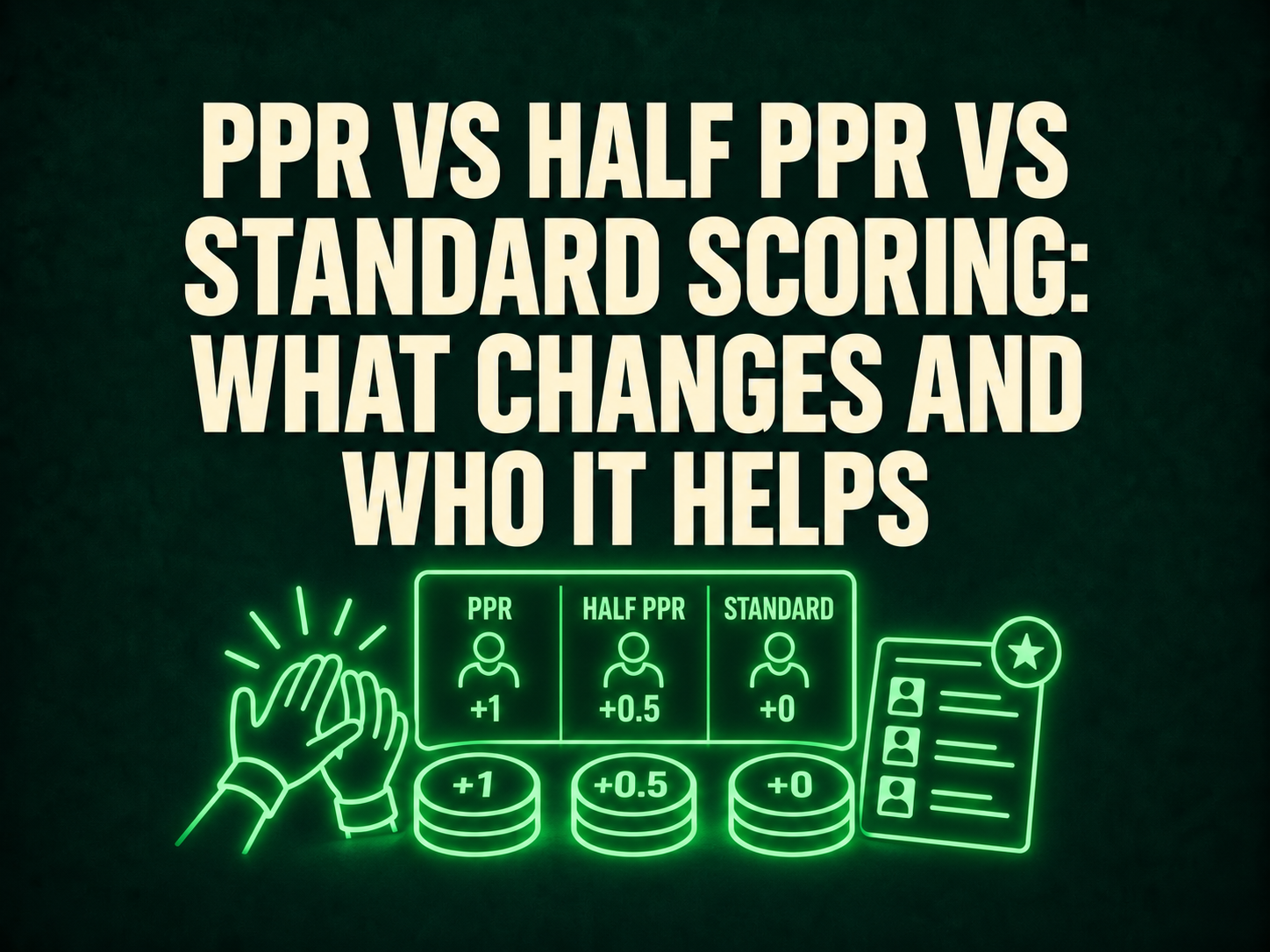
PPR, half PPR and standard are the three scoring formats almost every fantasy football league uses, and the whole difference between them is what a catch is worth. In PPR (points per reception) a catch is worth one point on its own, before any yards. In half PPR it is worth half a point. In standard it is worth nothing; only the yards and the touchdown count.
Everything else is usually the same across the three. Ten rushing or receiving yards is a point, a touchdown is six, twenty-five passing yards is a point, a passing touchdown is four. So the choice comes down to how much you want to pay for catches on their own, apart from what they gained.
The math on one player
Take a receiver with 7 catches for 84 yards and no score.
| Format | Catches | Yards | Total |
|---|---|---|---|
| Standard | 0 | 8.4 | 8.4 |
| Half PPR | 3.5 | 8.4 | 11.9 |
| PPR | 7.0 | 8.4 | 15.4 |
Same game, and he is nearly twice as valuable in PPR as in standard. A running back who carried 18 times for 84 yards with no catches scores 8.4 in all three.
Who gains and who loses
PPR rewards anyone who catches a lot of balls, whatever happens after the catch. Slot receivers who run short routes, pass-catching running backs, and tight ends with a steady target share all move up. A receiver with 90 catches for 900 yards outscores one with 60 catches for 1,000 yards; in standard that is reversed.
Standard rewards yards and touchdowns, so it favors the deep threat, the goal-line back, and the workhorse runner who never catches a pass. It also makes running backs worth more relative to receivers, because a back's carries count in full while a receiver's catches add nothing on their own.
Half PPR is the compromise most leagues have drifted toward. It keeps the volume receiver relevant without letting a 4-yard catch count as much as a 10-yard run, and half-PPR rankings sit between the other two, which is why so many published rankings default to it. If I were setting up a new league it is where I would start.
The more receptions count, the more a player's target share matters and the less his yards per catch does.
Why this changes a start or sit call
Two players can swap places on format alone. A possession receiver averaging 6 catches for 55 yards is a comfortable start in PPR and a bench player in standard. A deep threat averaging 3 catches for 70 yards is the reverse. Only the scoring changed.
That is why every page on our Start/Sit board has a Standard / Half PPR / PPR toggle at the top, and it changes the projected points on every card. The verdict itself is judged in PPR. We settled on that because it is the format most rankings and projections are published in, and if the toggle changed the judgment, one player would carry three different calls. When a non-PPR format would crown a different winner in a head-to-head, the calculator says so in a note under the verdict.
The weekly rankings page re-sorts on the toggle too, which is the quickest way to see how far a format moves a player. Flip it from standard to PPR and watch the pass-catching backs climb.
How to check your league's format
On Sleeper, open the league, then Settings, then Scoring; the "Reception" line shows 0, 0.5 or 1. On ESPN it is under League Settings, Scoring, "Each reception." Yahoo puts it in Commissioner Settings under Scoring. You can read the value without being the commissioner; you just cannot change it.
If you keep your roster in My Team, the format is saved with the roster, so the calls and projections come back in your scoring every week without touching the toggle. Importing from Sleeper reads the reception value from the league and sets it for you.
A few things people get wrong
"PPR inflates scores, so it is easier." Everyone in the league scores more, so nobody's week gets easier. What changes is who is worth starting.
"My draft rankings are PPR, so I am fine." Only if your league is. Drafting from PPR rankings into a standard league overpays for slot receivers and underpays for the goal-line back, and it is the most common way I have seen a good draft turn into a bad roster.
"Tight end premium is the same as PPR." It is a separate setting. Some leagues give tight ends an extra half point or full point per catch on top of the base format, to make the position worth rostering. If your league has it, a target-share tight end is worth more than any PPR ranking shows.
Where this fits
Check your league's reception value once, set the toggle to match, and read every call from there. If a start/sit decision is close, the format is usually why, and the calculator will tell you when it flips.
Time to Get Started?
Apply these insights with AI-powered statistics and analysis — free to start.
Get Started Free